Are Your Students Career Ready?
Career readiness is all about building the skills and confidence needed to succeed — not just in a first job, but throughout a whole career. These are career readiness competencies employers look for:
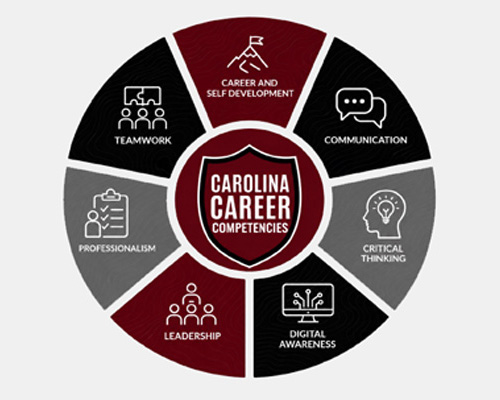
The University of South Carolina Career Center partners with Suitable and the National Association of Colleges and Employers (NACE) to support students’ career readiness development. Through NACE’s research-based Career Readiness Competencies and Suitable’s student engagement technology, students can reflect on how experiences such as internships, co-ops, and on-campus employment strengthen the skills employers value most. These insights help students recognize their growth, communicate their strengths, and continue building toward their career goals.
Explore the guides, tip sheets and assessment rubrics below for practical tools to help students identify, develop and communicate their career readiness competencies.
- Career Readiness Coaching Conversation Guide
- Competency Inventory Guide
- Developing Career-Ready Students Through Suitable
- Suitable Supervisor Competency Reference Rubric for Experiential Education
- Suitable Supervisor Competency Reference Rubric for Student Employment
- Suitable Supervisor Competency Reference Rubric for General Experience
- NACE Competency Assessment (Suitable) Student Tipsheet
Incorporating Career Readiness into Your Syllabi
Help students recognize how the skills they're developing in your classroom connect to their future careers. By identifying the NACE Career Readiness Competencies already incorporated into your coursework, you can highlight these connections through syllabus statements, assignments and activities without changing your existing curriculum. Explore the examples below for ideas you can easily adapt to your courses.
Example Syllabus Statements
This course will provide you with the development of the following essential skills: [insert relevant skill(s)]. These essential skills will help prepare you for future career opportunities including internships, jobs, and graduate school. You can learn more about these essential skills and how to connect them to your career at the USC Career Center, sc.edu/career.
Essential Skills Developed:
Communication: This course will build your verbal communication skills through weekly discussions on assigned readings. You will also have several presentations where you will share your research with the class. You will develop written communication skills through assignments including weekly reflections and a final paper.
Teamwork: This course will build your teamwork skills during your final paper/presentation assignment where you will work with a team to write a paper on a research topic and present your findings together to the class.
You can learn more about these essential skills and how to connect them to your career at the USC Career Center, sc.edu/career.
Example Assignments & Activities
Clearly and effectively exchange information, ideas, facts, and perspectives with others.
Examples: Writing papers and professional messages, presenting to the class or guests, discussing course topics with peers, creating presentation visuals, asking clarifying questions, practicing active listening, applying storytelling techniques, developing an elevator pitch.
Build and maintain collaborative relationships to work toward shared goals while valuing diverse viewpoints.
Examples: Group projects, partner lab work, co-writing assignments, adapting and compromising, managing conflict effectively.
Identify and respond to needs using situational context and logical analysis.
Examples: Solving course-related problems, gathering and interpreting data, engaging in debates, analyzing case studies, writing research papers, participating in service-learning projects, considering diverse perspectives.
Recognize and use personal and team strengths to achieve goals.
Examples: Planning and completing projects, solving problems creatively, evaluating peer work, building trust, motivating teammates, practicing ethical decision-making.
Demonstrate effective work habits and act responsibly within the academic or workplace community.
Examples: Meeting deadlines, attending class on time, upholding academic integrity, submitting error-free work, holding oneself and others accountable, reporting progress updates.
Use technology ethically and effectively to complete tasks and achieve goals.
Examples: Creating digital presentations, learning new tools, selecting appropriate technologies for tasks, manipulating information, understanding data privacy and security, teaching others how to use new technology.
Proactively develop one’s skills, knowledge, and career awareness.
Examples: Identifying strengths and areas for growth, applying feedback, seeking learning opportunities, using career assessments, exploring career paths, connecting with professionals, creating career materials (résumé/CV, cover letter, personal statement).
Student Email Template
We know students look to their professors and instructors for guidance, and your encouragement makes a real difference in how they engage with career development. We’ve created a brief email template you can share with your students to remind them of the many resources, programs, and events available through the USC Career Center. Feel free to customize the message to fit your course or communication style.